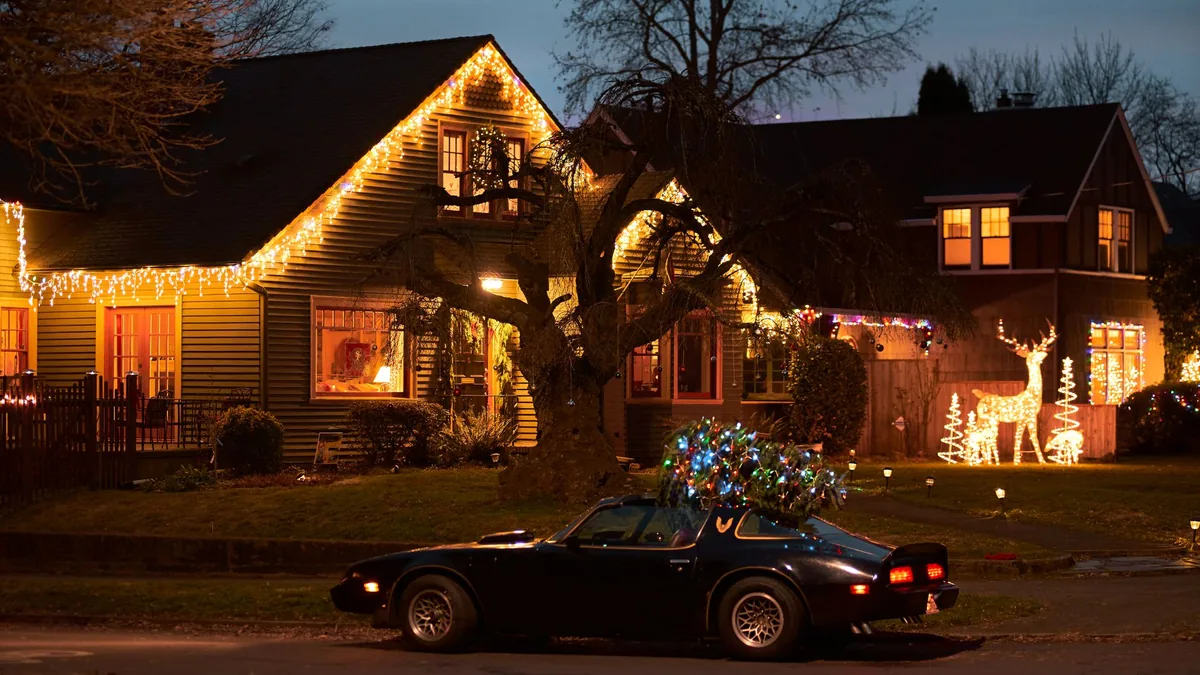
Every December the same two questions come up: how much are the Christmas lights adding to the electricity bill, and are the old ones from the loft still safe? The answer to the first is usually “less than you think”, especially with LEDs, but older filament sets and big outdoor displays can add up. The answer to the second depends on checking them properly before they go up.
AI is handy for both. Give it the wattage on the label, how long the lights are on and your electricity unit rate, and it will do the sums for each set and for the whole season. It can also turn electrical safety advice into a quick checklist for your own lights, and help you plan timers so nothing is left on overnight. This guide takes about 15 minutes.
Quick answer: Find the wattage (W) on each set’s label or box, decide how many hours a day they’ll be on, and find your electricity unit rate on your bill. Ask an AI chatbot to work out the cost per day and for the whole season using watts ÷ 1,000 × hours × unit rate. Then ask it for a safety checklist based on Electrical Safety First’s advice: check for damage, plug transformers in indoors, use outdoor-rated lights outside and switch everything off at bedtime.
New to AI? Start with our beginner’s guide.
What you’ll need
- The label, box or instructions for each set of lights, showing the wattage (W) and voltage
- Your electricity unit rate in pence per kWh, from your latest bill or your supplier’s app
- A rough idea of how many hours a day and how many days the lights will be on
- An AI chatbot such as ChatGPT, Claude, Gemini or Grok
- About 15 minutes
Step-by-step: check the cost and safety of your Christmas lights with AI
- List your lights. For each set, note where it goes (tree, window, outside), whether it’s LED or filament, and the wattage. If the wattage isn’t shown, check the box or the manufacturer’s website rather than letting the AI guess.
- Find your unit rate. Your bill shows what you pay per kWh. As a guide, Ofgem says the average price cap rate for electricity from 1 October to 31 December 2026 is 26.32p per kWh for Direct Debit customers on a standard variable tariff, with VAT removed from electricity bills until 31 March 2027. Your own rate may be different.
- Do the sums. Paste your list into the AI and ask it to work out the cost per day, per week and for the season (prompt 1). The formula is watts ÷ 1,000 × hours on × unit rate. For example, a 5 W LED set on for 8 hours a day uses 0.04 kWh, about 1p a day at 26.32p, or around 32p over 30 days. A 60 W set on for the same time costs about 13p a day, or around £3.79 over 30 days.
- Compare LED and older sets. Electrical Safety First says LED Christmas lights can use 80 to 90% less electricity than filament lamps. Ask the AI whether replacing an old set would pay for itself, and how long it would take (prompt 2).
- Run a safety check before they go up. Ask the AI to turn the advice below into a checklist for your lights (prompt 3). Check every set for frayed or damaged cables, broken bulbs and loose wires. Electrical Safety First says lights with damaged cables or fittings should be replaced, not repaired.
- Check outdoor lights properly. Only use lights outside if they’re designed for it. Electrical Safety First says outdoor lights should show a water drop symbol or an IP rating with a last digit of 3 or higher, and should be plugged in indoors through a 30mA RCD-protected socket.
- Plan timers and switch-off. Switch lights off and unplug them before you go to bed or go out. Ask the AI to plan a timer schedule that covers the evenings you want them on (prompt 4), which also keeps the running cost down.
Copy-paste prompts
1. Work out what my lights cost to run
Here are my Christmas lights: [FOR EACH SET: WHERE IT GOES, LED OR FILAMENT, WATTAGE]. They'll be on about [HOURS] hours a day from [START DATE] to [END DATE]. My electricity unit rate is [PENCE] per kWh.
Work out the cost per day, per week and for the whole period for each set and in total, using watts ÷ 1,000 × hours × unit rate. Show your working in a table and round to the nearest penny. Don't guess any wattage I haven't given you; ask me instead.
2. Is it worth swapping to LED?
I have an old [FILAMENT / LED] set of Christmas lights rated at [WATTAGE] W, on for about [HOURS] hours a day for [NUMBER] days a year. A replacement LED set rated at [WATTAGE] W costs [PRICE]. My unit rate is [PENCE] per kWh.
Work out what each set costs to run per year and how many Christmases it would take for the new set to pay for itself. Mention any non-money reasons to replace the old set, such as damage or age.
3. My Christmas lights safety checklist
I'm putting up these lights: [LIST SETS, WHERE THEY GO AND WHETHER THEY'RE INDOOR OR OUTDOOR]. Some are [AGE] years old and have been stored in [LOFT / GARAGE / CUPBOARD].
Make a short safety checklist to run through before I put them up, based on UK electrical safety advice: checking cables and bulbs, replacement bulbs, outdoor ratings and RCD protection, where plugs and transformers go, sockets and extension leads, children and pets, and switching off at night. Tell me which sets I should replace rather than use.
4. A timer schedule for my lights
It gets dark around [TIME] and we usually go to bed around [TIME]. I have [NUMBER] smart plugs or plug-in timers for these lights: [LIST]. We're away from [DATES, IF ANY].
Suggest a simple on-off schedule for each set that covers the evenings and switches everything off before bedtime, and tell me how much it saves compared with leaving them on [HOURS] hours a day at [PENCE] per kWh.
Recommended tools
- ChatGPT: quick at running the sums for several sets and laying them out as a table
- Claude: clear explanations of the formula and careful with assumptions
- Gemini: handy if you want to put your lights list into Google Sheets
- Grok: fast for a quick check of one set’s running cost
Not sure what your unit rate is? Our guide to understanding your energy bill and meter readings with AI shows where to find it. Prices change again on 1 January, so see how to prepare for the January energy price cap change with AI, and if you’re going away, use the same timers to make the house look lived in with our guide to securing your home when you go away for Christmas with AI.
Tips and mistakes to avoid
- Check the AI’s maths. Chatbots sometimes slip on decimals. Run one set through a calculator yourself: watts ÷ 1,000 × hours × pence per kWh.
- Use your own rate. The Ofgem figure is an average for Direct Debit customers. Fixed tariffs, prepayment, Economy 7 and different regions can all be different, and the cap changes again on 1 January 2027.
- Buy from reputable retailers. Electrical Safety First advises buying from a reputable retailer rather than a third-party seller online, as lights may not have passed the necessary safety checks.
- Don’t overload sockets. Avoid relying on extension leads and adaptors where you can, and never plug extension leads into each other.
- Plug transformers in indoors. Even outdoor-rated lights should have their plugs and transformers indoors, away from flammable decorations.
- Replace bulbs like for like. Only use replacement bulbs of the same type and rating as the originals, and never change bulbs while the lights are plugged in.
- Register new lights. Electrical Safety First suggests registering your Christmas lights so you can be contacted if there’s a safety recall.
FAQ
How much do Christmas lights cost to run?
It depends on the wattage, the hours they’re on and your unit rate. A typical small LED set costs pennies a day to run, while older filament sets and large displays cost more. Use watts ÷ 1,000 × hours × unit rate, or ask the AI to do it with prompt 1.
Are LED Christmas lights cheaper to run?
Yes. Electrical Safety First says LED Christmas lights can use 80 to 90% less electricity than filament lamps, and they also produce less heat.
Is it safe to leave Christmas lights on overnight?
Electrical Safety First advises switching Christmas lights off and unplugging them before you go to bed or go out. A timer or smart plug makes this easy.
Try it yourself with ChatGPT
Here are my Christmas lights: [FOR EACH SET: WHERE IT GOES, LED OR FILAMENT, WATTAGE]. They'll be on about [HOURS] hours a day from [START DATE] to [END DATE]. My electricity unit rate is [PENCE] per kWh.
Work out the cost per day, per week and for the whole period for each set and in total, using watts ÷ 1,000 × hours × unit rate. Show your working in a table and round to the nearest penny. Don't guess any wattage I haven't given you; ask me instead.
Try the next prompt: add your lights to the rest of your festive budget with our guide to planning Christmas and holiday spending with AI
Read next
Get the free AI Agents Playbook
50 practical AI workflows, plus one practical how-to a week in your inbox.
Free. No spam. Unsubscribe any time.
Reference: Electrical Safety First: Christmas lights