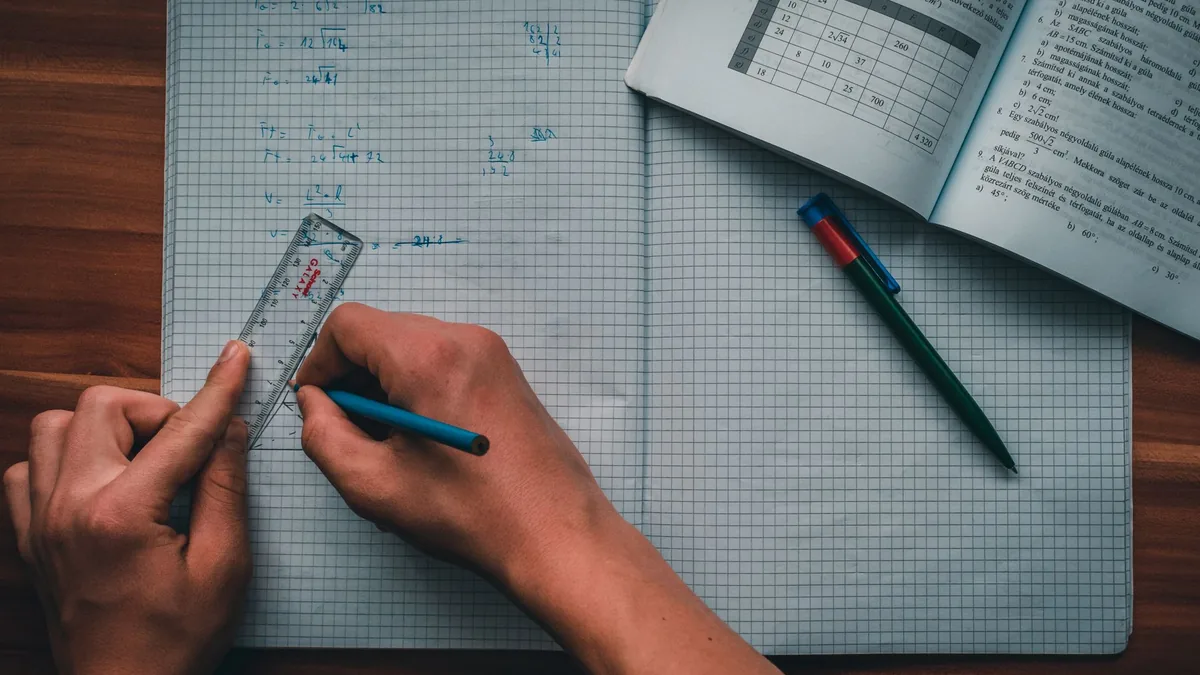
Lots of people say they’re “not a maths person”, usually because a topic didn’t click at school and the class moved on anyway. Maths builds on itself, so one shaky foundation, like fractions or algebra, can make everything after it feel impossible. The good news is that with patient, step-by-step explanations, almost anyone can get better at maths.
AI can be that patient tutor. It will explain a topic five different ways, never sighs, and can produce endless practice questions at exactly your level. It can check your working and show you where you went wrong. The catch: AI does sometimes make maths mistakes, and simply copying its answers won’t help you learn. This guide shows how to use it well. It takes about 30 minutes a session.
Quick answer: Tell an AI chatbot your level and the topic you’re stuck on, and ask it to explain it step by step with a simple example, then check you understand by asking you a question. Try practice questions yourself, show your working and ask the AI to check it. Ask for hints rather than answers, use BBC Bitesize to check methods, and double-check AI answers with a calculator.
What you’ll need
- The topic you’re working on and your level (such as KS3, GCSE Foundation or Higher)
- Pen and paper for working things out
- A calculator for checking
- An AI chatbot and about 30 minutes per session
- BBC Bitesize or your textbook to cross-check methods
Step-by-step: learn maths with AI
- Find your starting point. Ask the AI to give you a short diagnostic quiz on the topic (prompt 1). It helps uncover the earlier skill that’s actually causing trouble.
- Get a clear explanation. Ask for a step-by-step explanation with one worked example (prompt 2). If it doesn’t click, ask for a different approach, such as a picture, a real-life example or smaller steps.
- Try it yourself. Ask for a few questions at your level. Work them out on paper before typing your answers.
- Show your working. Type in your steps and ask the AI to check them (prompt 3). Spotting where a method went wrong is where the real learning happens.
- Ask for hints, not answers. When stuck, ask for a nudge. Tell the AI not to give the full answer.
- Mix it up. Once you’re confident, ask for mixed questions and exam-style problems (prompt 4).
- Check with trusted sources. Compare methods with BBC Bitesize or your teacher’s notes, and double-check calculations, as AI can get arithmetic wrong.
Copy-paste prompts
1. Where am I going wrong?
I'm studying [LEVEL, SUCH AS GCSE FOUNDATION] and I'm struggling with [TOPIC]. Give me a short diagnostic quiz of 6 questions, starting easy and getting harder, one at a time. Wait for my answer each time. At the end, tell me which underlying skill I most need to work on.
2. Explain it step by step
Explain [TOPIC] to me as if I'm a [LEVEL] student who finds maths difficult. Use small steps, plain language and one worked example. Then ask me one simple question to check I've understood before moving on. If I get it wrong, explain it a different way.
3. Check my working
Here's a question and my working: [PASTE QUESTION AND YOUR STEPS].
Check each step. If I've made a mistake, tell me which step it's in and give me a hint to fix it, but don't give me the final answer. Then give me a similar question to try.
4. Mixed practice
Give me 8 mixed practice questions on [TOPICS] at [LEVEL], including 2 worded problems in an exam style. Number them and don't show answers. When I send my answers, mark them, explain any I got wrong and tell me what to practise next.
Recommended tools
- ChatGPT: great for step-by-step explanations; many plans can read a photo of your working.
- Claude: patient explanations and careful checking.
- Gemini: handy if you work in Google Classroom or Docs.
- Grok: quick for a fast explanation.
- BBC Bitesize: free, curriculum-based maths guides and practice.
Tips and mistakes to avoid
- Don’t just copy answers. You won’t remember the method, and exams won’t let you bring AI.
- Always check calculations. AI can make arithmetic slips. Use a calculator.
- Say your level. An explanation for A level won’t help you at KS3.
- Go back a step. If a topic won’t click, the problem is often an earlier skill.
- Little and often. Twenty minutes a day beats a three-hour cram.
- Use paper. Writing working by hand helps you think and remember.
- Follow school rules. Don’t use AI on homework where your teacher has said not to.
FAQ
Is AI accurate at maths?
It’s improved a lot but still makes mistakes, especially with long calculations. Use it for explanations and checking methods, and verify numbers yourself.
Can I upload a photo of my homework?
Many chatbots can read photos. Use it to check your working or get hints, not to get answers to hand in.
Can AI help adults learn maths?
Absolutely. Many adults use AI to brush up on maths for work, money or helping their children. Free courses are also available through adult education services.
How do I know which topics to revise for my exam?
Ask your teacher or check your exam board’s specification, then ask the AI to turn that list into a weekly revision plan that mixes topics you find hard with ones you’re already confident about.
Try it yourself with ChatGPT
I'm studying [LEVEL, SUCH AS GCSE FOUNDATION] and I'm struggling with [TOPIC]. Give me a short diagnostic quiz of 6 questions, starting easy and getting harder, one at a time. Wait for my answer each time. At the end, tell me which underlying skill I most need to work on.
Get the free AI Agents Playbook
50 practical AI workflows, plus one practical how-to a week in your inbox.
Free. No spam. Unsubscribe any time.
Related guides
- How to use AI to revise for exams (without cheating)
- How to use AI to make flashcards from your notes
- How to use AI to understand a difficult textbook chapter
Reference: BBC Bitesize: Maths