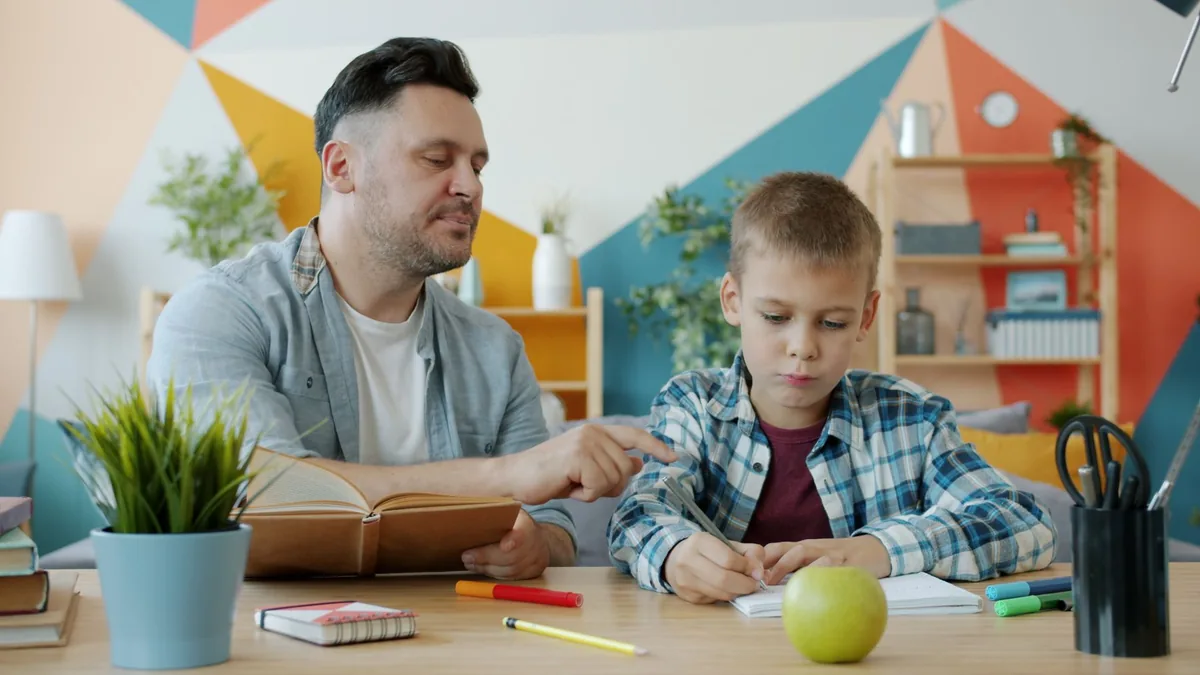
“Can you help me with my homework?” can strike fear into any parent. Maths is taught differently now, you last thought about photosynthesis in 1998, and the worksheet seems to assume knowledge nobody explained. It’s tempting to just give the answer so everyone can get to dinner. But homework is meant to help children practise and think for themselves.
AI can be a great help, for you as much as your child. It can quickly refresh your memory on a topic, explain the methods schools use today, suggest questions to ask that guide your child towards the answer, and make up extra practice. Used the wrong way, it can also do the homework for them, which helps nobody. This guide shows how to use it well. It takes about ten minutes before a homework session.
Quick answer: Use an AI chatbot to refresh your own understanding first: ask it to explain the topic at your child’s year group and how it’s usually taught in UK schools. Then ask for guiding questions and hints rather than answers. Let your child do the thinking and writing, check their work together, and use BBC Bitesize for trusted explanations. Follow the school’s rules on AI use.
What you’ll need
- The homework task and your child’s year group
- Ten minutes for you to get up to speed first
- An AI chatbot for you (check age limits before letting children use one themselves)
- BBC Bitesize for curriculum-based explanations and videos
Step-by-step: help with homework using AI
- Understand the task yourself. Read the homework and ask the AI to explain the topic at your child’s level (prompt 1). Ask how it’s usually taught now, especially for maths methods like the bus stop method for division.
- Ask your child to explain first. Before helping, ask what they think the task is asking and what they already know. You’ll find out where they’re stuck.
- Use guiding questions. Ask the AI for questions you can ask to nudge your child without giving the answer (prompt 2).
- Give hints, not answers. If they’re stuck, offer one small hint at a time. Let them do the writing.
- Make extra practice. If they’re struggling with something, ask the AI for a few similar practice questions at the right level (prompt 3).
- Check it together. Ask your child to talk you through their answer. If something’s wrong, ask “how did you get that?” rather than correcting it straight away.
- Talk to the teacher if needed. If homework regularly causes tears, let the school know. Ask the AI to help draft a friendly note (prompt 4).
Copy-paste prompts
1. Explain this topic to me
My child is in [YEAR GROUP] at a school in [ENGLAND / SCOTLAND / WALES / NORTHERN IRELAND]. Their homework is about [TOPIC]. I've forgotten how this works.
Explain it to me in plain English, then explain how it's usually taught to children of this age, including any methods or vocabulary the school might use. Keep it short, and tell me what mistakes children commonly make.
2. Questions to guide my child
My child is doing this homework: [DESCRIBE OR PASTE THE TASK]. They're stuck on [WHAT'S HARD].
Give me 5 questions I can ask, in order, to help them work it out themselves, starting with very open questions and getting gradually more specific. Don't give the answer.
3. Extra practice at the right level
My child is in [YEAR GROUP] and finds [TOPIC] hard. Write 6 practice questions that start very easy and get slightly harder, with answers listed separately at the end for me. Make them fun, with a theme they'd like, such as [INTEREST].
4. Note to the teacher
Help me write a short, friendly note to my child's teacher. My child is in [YEAR GROUP] and has been finding [SUBJECT OR TYPE OF HOMEWORK] very difficult. What we've noticed: [DETAILS]. I'd like to ask [QUESTIONS]. Keep it positive and under 120 words.
Recommended tools
- ChatGPT: quick explanations and practice questions for parents.
- Claude: patient, clear explanations of tricky topics.
- Gemini: handy if your child’s school uses Google Classroom.
- Grok: quick refreshers on facts and topics.
- BBC Bitesize: free curriculum guides, videos and games for every age.
Tips and mistakes to avoid
- Don’t hand in AI work. Homework is practice. If AI does it, your child misses out and the teacher can’t see where help is needed.
- Check age rules. Many AI chatbots have minimum ages. Supervise any use by children and follow the school’s policy.
- Verify facts. AI can be wrong. Cross-check with Bitesize or the textbook.
- Keep it short. For younger children, a tired 20 minutes is better than an hour of tears.
- Praise effort. “You kept going even when it was hard” builds resilience.
- Learn together. Showing that you also look things up teaches a great habit.
- Protect privacy. Don’t share your child’s full name or school with AI tools.
FAQ
Is it cheating to use AI for homework?
Using it to explain or practise is usually fine; using it to do the work is not. Check your school’s rules.
How do I help if I don’t understand the topic at all?
Start with prompt 1 and a Bitesize video. Learning alongside your child is perfectly fine.
Should my child use AI on their own?
It depends on their age, the tool’s age limits and the school’s guidance. Supervise younger children and talk about using it honestly.
How much help is too much?
A good rule is that your child should be able to explain every answer in their own words. If they can’t, you’ve probably done too much of the thinking. Step back, ask a question instead and let them try again.
Try it yourself with ChatGPT
My child is in [YEAR GROUP] at a school in [ENGLAND / SCOTLAND / WALES / NORTHERN IRELAND]. Their homework is about [TOPIC]. I've forgotten how this works.
Explain it to me in plain English, then explain how it's usually taught to children of this age, including any methods or vocabulary the school might use. Keep it short, and tell me what mistakes children commonly make.
Get the free AI Agents Playbook
50 practical AI workflows, plus one practical how-to a week in your inbox.
Free. No spam. Unsubscribe any time.
Related guides
- How to use AI to learn maths step by step
- How to use AI to create bedtime stories for children
- How to use AI to revise for exams (without cheating)
Reference: BBC Bitesize Parenting