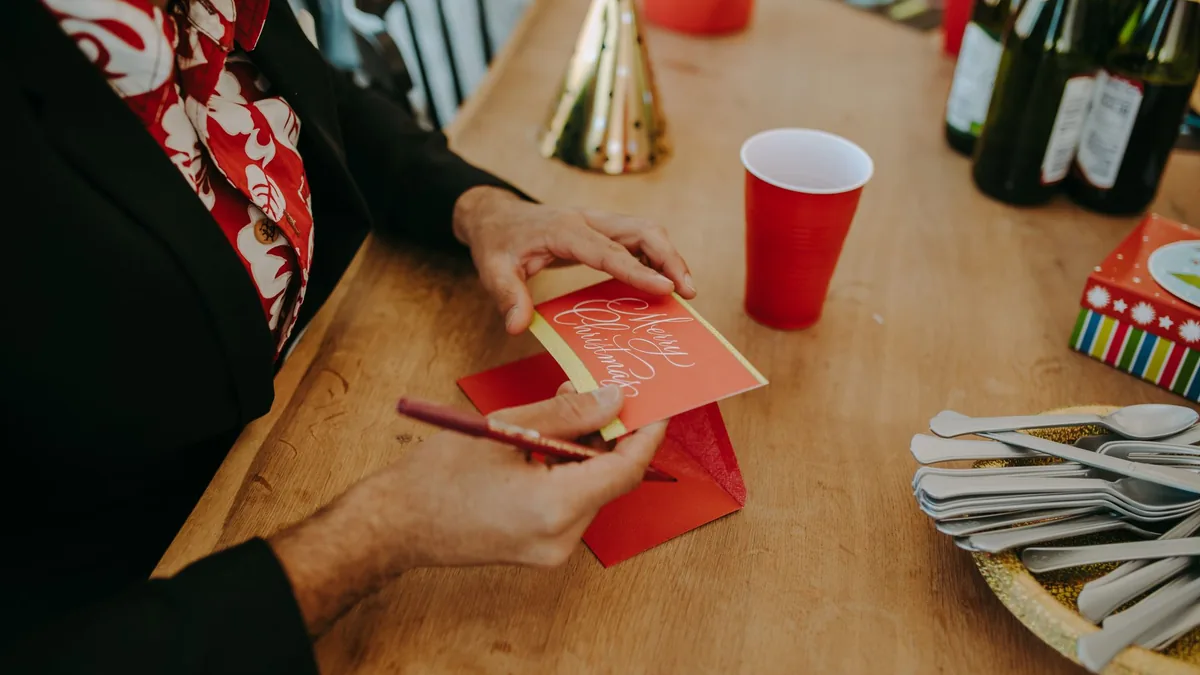
December is when many families want to thank the people who look after their children all year: class teachers, teaching assistants, nursery staff, childminders, after-school carers and the relative who does the school run. Expensive gifts pile pressure on parents and make teachers uncomfortable. Parent groups and teaching unions have long said a simple, heartfelt thank you is enough.
AI is useful here because the hard part is finding the specific detail that makes a note feel real, not generic. Tell a chatbot who you’re thanking and one or two things they did this term, and it can draft a short card message a child can sign, or a longer note from a parent or carer. This guide takes about 15 minutes and works whether you’re writing one card or a stack for the whole class team.
Quick answer: List who you’re thanking (teacher, TA, carer) and one or two specific things they did this term. Ask an AI chatbot for a short Christmas card message (about 40 to 80 words) in a warm, plain British tone, with a version a child can sign and a slightly longer parent version. Skip expensive gift ideas unless you ask for a small, low-cost option. Parent bodies such as Connect have said a heartfelt thank you is enough.
New to AI? Start with our beginner’s guide.
What you’ll need
- Names and roles of the people you’re thanking (class teacher, TA, nursery key person, childminder, grandparent who helps)
- One or two specific examples from this term (a subject they helped with, a kind moment, progress you noticed)
- Whether the note is from the child, from you, or both
- Card or paper, or an email if the school prefers that
- An AI chatbot: ChatGPT, Claude, Gemini, Grok or Microsoft Copilot
Step-by-step: write Christmas thank-you notes with AI
- Make your list. Write every adult you want to thank this Christmas: teacher, TA, lunchtime supervisor, club leader, childminder or family carer. Note how you know them.
- Collect one specific detail each. The Tes coverage of Connect’s advice stresses that a heartfelt thank you matters more than a gift. A specific line (“thank you for helping Sam with reading on Tuesday mornings”) beats “thanks for everything”.
- Set the tone and length. Ask for a short card message (two or three sentences) in plain British English, warm but not gushing, with no religious wording unless you want it (prompt 1).
- Draft a child-friendly version. If your child will write or sign the card, ask for a version in simple words they can copy, and a slightly fuller parent version for the same person (prompt 2).
- Cover carers and support staff too. Don’t stop at the class teacher. Ask the AI to adapt the same structure for a TA, nursery key person, childminder or relative who regularly cares for your child (prompt 3).
- Keep gifts optional and low-cost. If your school culture still involves a small gift, ask the AI for low-cost or handmade ideas under a budget you set, and never for competing or expensive options. Many teachers say generous presents make them uncomfortable.
- Edit in your own voice. Read the draft aloud, swap in your child’s real examples, and cut anything that sounds like a template. Handwrite the final line if you can.
Copy-paste prompts
1. Draft a Christmas thank-you card for a teacher
Write a short Christmas thank-you message for [NAME], who is my child's [ROLE, E.G. YEAR 4 TEACHER] at [SCHOOL TYPE, E.G. PRIMARY SCHOOL].
Specific things to mention: [1 OR 2 REAL EXAMPLES FROM THIS TERM].
Tone: warm, plain British English, sincere, not gushing or formal. About 40 to 80 words, suitable for a greetings card. No religious wording unless I ask. End with a simple Christmas wish. Give me two options.
2. Child version and parent version
Using this draft: [PASTE DRAFT]
1) Rewrite it so a [AGE]-year-old can copy it in their own handwriting (short sentences, everyday words).
2) Rewrite a slightly longer parent version that keeps the same specific details.
Keep both warm and specific. Flag any line that still sounds generic.
3. Thank a carer or support staff member
Write a Christmas thank-you note for [NAME], who is our [TEACHING ASSISTANT / NURSERY KEY PERSON / CHILDMINDER / AFTER-SCHOOL CARER / FAMILY CARER].
They help by [WHAT THEY DO]. Specific moment to mention: [EXAMPLE].
Keep it short enough for a card, warm and specific, and suitable to hand over with a homemade biscuit or no gift at all. Offer a one-sentence version and a short paragraph version.
4. Low-cost optional gift ideas (only if needed)
Our budget for optional teacher or carer gifts is [AMOUNT] per person. Suggest 5 small, thoughtful ideas that are homemade or under budget, and that won't create pressure on other families. Avoid alcohol, strong perfume and anything that needs the person's address. Remind me that a written thank you alone is enough.
Recommended tools
- ChatGPT, Claude, Gemini or Grok: best for drafting and shortening card messages
- Microsoft Copilot: handy if you already write in Word or Outlook
- A real card or note paper: handwriting the final version makes it feel personal
Want a handmade gift that still keeps costs down? Make a personalised photo calendar in Canva. Planning class or club activities through December? See how to plan an advent calendar of activities with AI, and if you’re looking beyond presents, try finding Christmas volunteering with AI.
Children have thank-yous to write too. Our guide to helping your child write thank-you letters after Christmas with AI has age-by-age templates.
Tips and mistakes to avoid
- Be specific. “Thanks for everything” is forgettable. One real example is what people remember.
- Thank the whole team when you can. TAs and lunchtime staff are often overlooked.
- Don’t compete on gifts. Parent groups and unions have warned that extravagant Christmas presents for teachers are unfair on families and unnecessary.
- Check school rules. Some schools limit gifts or ask for donations to a class fund instead.
- Let children help. A short line in their handwriting next to your note means more than a perfect paragraph.
- Proof names and classes. AI will invent a year group if you leave a blank; fill every bracket yourself.
FAQ
Is a card enough, or do teachers expect a gift?
A card with a specific thank you is enough. Connect (the Scottish parent body) has said a simple and heartfelt thank you is enough, and teaching unions have pointed out that Christmas gifts for teachers are unaffordable for many families.
What should I write if my child had a difficult term?
Be honest and kind. Thank them for patience, clear communication or a particular bit of support. You don’t need to pretend the year was easy.
Can I use the same note for every teacher?
Use the same structure, but change the specific example each time. Identical cards feel copied; one true detail makes each note yours.
Try it yourself with ChatGPT
Write a short Christmas thank-you message for [NAME], who is my child's [ROLE, E.G. YEAR 4 TEACHER] at [SCHOOL TYPE, E.G. PRIMARY SCHOOL].
Specific things to mention: [1 OR 2 REAL EXAMPLES FROM THIS TERM].
Tone: warm, plain British English, sincere, not gushing or formal. About 40 to 80 words, suitable for a greetings card. No religious wording unless I ask. End with a simple Christmas wish. Give me two options.
Try the next prompt: write the rest of your family Christmas cards, including a round-robin letter, with our guide to writing Christmas cards and round-robin letters with AI
Read next
Get the free AI Agents Playbook
50 practical AI workflows, plus one practical how-to a week in your inbox.
Free. No spam. Unsubscribe any time.
Reference: Tes: Parents told to stop buying Christmas presents for teachers